Roof Repair in Clearwater, FL:
The Cause Found, the Fix Photographed.
Roof repair in Clearwater for every age of home, from 1920s bungalows to 2000s builds. We track down what actually failed, fix it, and show you the before and after in photos. If a repair is the right call, that's what you get quoted.
Takes about 30 seconds. A local roofing specialist follows up the same business day.
Roof Repair on Clearwater’s Older Homes
The oldest parts of Clearwater, around downtown, Harbor Oaks and the streets that run down to the bay, have homes from the 1910s through the 1950s. Their roofs have usually been repaired many times, by many different people. That history is what makes a roof repair in Clearwater on one of these houses tricky.
A patch often sits on top of an older patch. Flashing at a chimney or a wall may have been covered with sealant over and over instead of being replaced. Underneath, the decking is often wood planks rather than plywood, and planks shrink and gap over the decades. When water shows up inside, the cause is usually one of these old fixes giving out, not the shingles themselves.
On these roofs we open up the area around the problem before we decide anything, and we photograph what we find. Sometimes the right repair is bigger than the stain suggested. Sometimes it’s smaller. Either way you see the reason.
Roof Repair in 1970s and 1980s Clearwater Subdivisions
About 28,500 Clearwater homes were built in the 1970s and 1980s, including much of Countryside and the neighborhoods out toward US-19 and McMullen-Booth Road. By now most of them are on their second or third roof, and the repairs we see on them follow a pattern:
- Pipe boots. The rubber collar around each plumbing vent cracks in the sun well before the shingles around it are worn out. The leak usually turns up over a bathroom or the kitchen.
- Flashing at walls and valleys. Where a roof slope meets a wall or another slope, the metal can lift or rust through, especially if it wasn’t replaced at the last re-roof.
- Lifted shingle edges. After years of heat, the seal strips weaken, and summer gusts start lifting tabs along the eaves and rakes.
- Soft decking at the eaves. Overflowing gutters soak the edge of the deck year after year until it gives underfoot.
Most of these are true repairs, quick to fix when they’re caught early.
- Pipe boots The rubber collar cracks in the sun
- Wall and chimney flashing Lifts or loses its sealant
- Valleys Two roof planes drain through one channel
- Lifted shingles Storm gusts break the seal strip
- Skylights and vents Seals age out around the edges
- Flat-to-pitched seams Where a porch or addition ties in
Repairs Near the Water
Homes on Clearwater Beach, Island Estates, Sand Key and the bayfront have one more enemy: salt. It corrodes nails, screws, drip edge and flashing much faster than on the mainland. A roof covering that still looks fine can be held on by fasteners that are rusting away underneath it.
When we repair a roof near the water, we check the metal parts as closely as the shingles or tile, and the repair uses fasteners and trim suited to salt air. Replacing a few shingles with ordinary nails on a beach house just sets up the next repair.
Tracing a Clearwater Roof Leak Back to Where It Starts
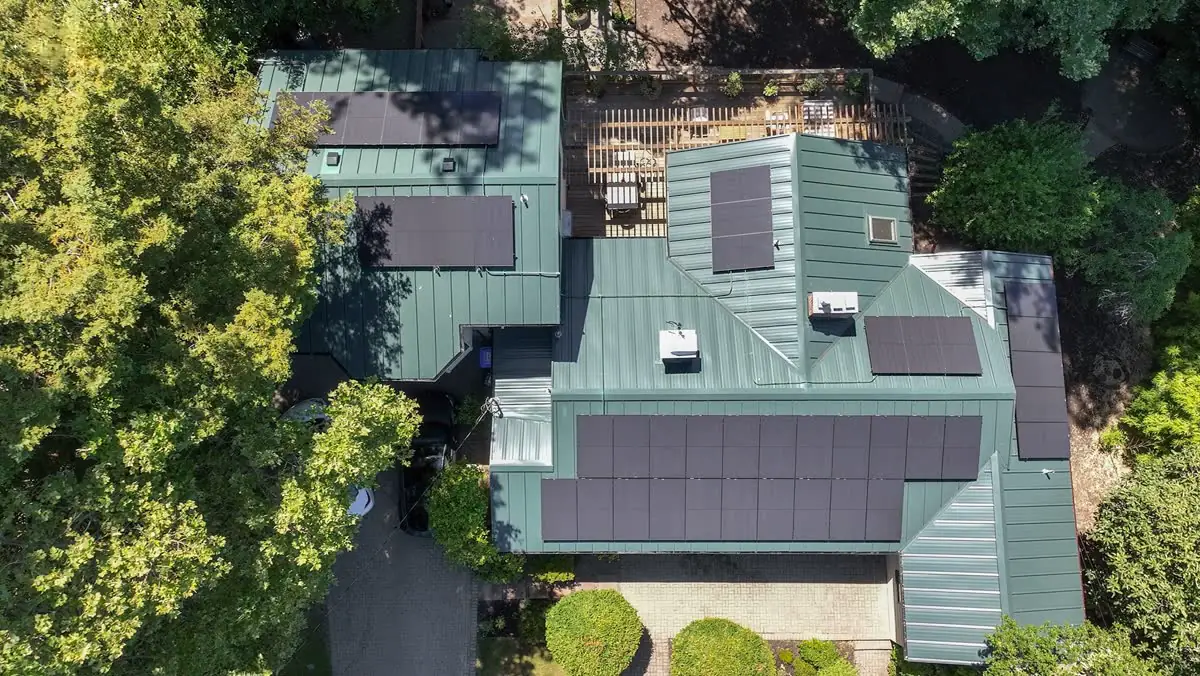
The most common reason a roof gets “fixed” three times is that the first fix went in the wrong place. Water that gets past a shingle or a piece of flashing doesn’t drop straight through. It runs down the underlayment, along a rafter or across the top of the ceiling drywall, and shows up as a stain somewhere downhill. On a hip roof or a house with a few additions, that can be several feet from the actual opening.
So we start above the stain and work uphill. Pipe boots, vents, skylight curbs, the flashing where a lower roof meets a wall, and valleys all get checked in that order. In the attic, water marks on the decking and framing usually point straight to the source. On older Clearwater homes with plank decking, light showing between the boards on a sunny day can give it away too.
When we find it, we photograph it before anything is touched. That photo, next to the one of the finished repair, is how you know the problem that’s fixed is the problem you had.
If water is coming in right now, say so when you send your address, and the visit starts with stopping it.
Roof Repair for Shingle, Tile, Metal and Flat Roofs
Clearwater has every type of roof, and each one is repaired differently:
- Shingle: damaged shingles are replaced and sealed in, with new pipe boots and flashing where the old ones failed.
- Tile: cracked tiles are replaced and slipped ones reset. When the leak is coming through the underlayment under the tile, the tile in that area is lifted, the underlayment repaired, and the tile put back.
- Metal: loose or corroded fasteners are replaced, failed sealant at seams and trim redone, and flashing at walls and penetrations repaired.
- Flat and low-slope: the membrane is patched or replaced, with special attention to where the flat section meets the pitched roof.

Do Clearwater Roof Repairs Need a Permit?
The City of Clearwater requires a permit to install or replace any roofing component. The one exception it lists is a very small leak repair under $500. So a few shingles might not need a permit, but most real repairs do. For a Clearwater mailing address in unincorporated Pinellas County, the county’s rules apply instead.
When a permit is needed, we pull it in our name and close it out after the inspection. You never have to file anything yourself.
Does Your Clearwater Repair Need a Permit?
- Very small leak repair under $500
- No permit needed, per the City of Clearwater
- Anything larger, or any roofing component replaced
- Permit required, pulled by us in our name
- Clearwater address outside city limits
- Pinellas County rules and permits apply instead
When Repairs Pass 25% of the Roof
Florida has a rule that comes up a lot on older Clearwater roofs. If 25% or more of a roof is repaired or replaced within 12 months, roofs built to the 2007 Florida Building Code or later only need the repaired section to meet current code. Roofs installed before that don’t get the same allowance, and a big enough repair can mean the whole roof has to be brought up to code.
That’s the moment when a repair turns into a replacement, whether you planned on it or not. The inspection photos tell you which side of the line you’re on before you get a price, so there are no surprises later. If replacement is the better answer, the same visit gives us what we need for a roof replacement quote.
When a Repair Turns into a Re-Roof
How a Roof Repair in Clearwater Works with Us
- 01
Send Your Address
Your roof is measured from high-resolution imagery right away.
- 02
We Find the Cause
The free inspection traces the leak or damage to its source and photographs it.
- 03
We Fix It
The repair is quoted as a repair and done with materials matched to your roof.
- 04
You See the Result
Before and after photos go into your portal, along with the permit when there is one.
Roofs We're Proud Of
Year workmanship warranty in writing, and it comes on top of the manufacturer's warranty for your materials.
We file every permit and build to the Florida Building Code. You don't fill out a single form.
We haul away the old roof and run a magnetic sweep for nails, so the yard looks the way it did before we came.
Florida certified roofing contractor CCC1336568, carrying liability insurance and workers' comp.
Monthly payment options, so you can replace the roof now and pay over time.
Roof Repair Questions from Clearwater Homeowners
Is My Roof Worth Repairing, or Is It Time for a New One?
If the trouble is in one area and the rest of the roof is sound, a repair usually makes sense. If the shingles are brittle and losing granules everywhere, or there are leaks on several slopes, money spent on repairs tends to be money spent twice. The free inspection shows you which it is, with photos.
Do Small Roof Repairs in Clearwater Need a Permit?
A very small leak repair under $500 doesn't, according to the city. Anything beyond that, or replacing any roofing component, needs one, and we pull it ourselves. Clearwater addresses in unincorporated Pinellas follow county rules.
Can You Repair a Roof on a House Built in the 1920s or 1940s?
Yes. We just expect surprises. Plank decking, old flashing and earlier patches are common on Clearwater's oldest homes. We photograph what we find before we fix it so you can see why the repair is what it is.
Why Do My Repairs Keep Failing in the Same Spot?
Usually because the patch went where the stain was, not where the water got in. Water runs along the decking and framing before it shows inside. We trace it back to the source, often a flashing joint or a pipe boot uphill from the stain.
Will New Shingles Match My Old Ones?
Close, but rarely perfectly. Shingles fade in the Florida sun, and colors change over the years. We match as closely as current products allow and tell you up front how it will look.
My Home Is on Island Estates. Anything Different About Repairs There?
Salt air corrodes nails, screws and trim faster than on the mainland, so we check the metal parts as closely as the roof covering and use fasteners and trim suited to the coast for the repair.
Is There a Way to Pay for a Repair Over Time?
Yes. You can choose monthly payments on a repair, not just on a new roof.

Get Your Clearwater Roof Measured, Free.
Enter your address. We'll handle everything else.